Lorem ipsum dolor sit amet, consectetur adipiscing elit, sed do eiusmod tempor incididunt ut labore et dolore magna aliqua. Ut enim ad minim veniam, quis nostrud exercitation ullamco laboris nisi ut aliquip ex ea commodo consequat. Duis aute irure dolor in reprehenderit in voluptate velit esse cillum dolore eu fugiat nulla pariatur.
Deepgram vs Gladia: Which speech-to-text API powers your application the best (in 2026)?
Published on Feb 10, 2026
By Matija Laznik
Choosing between Deepgram and Gladia for your speech-to-text and audio intelligence needs comes down to these five critical questions:
Do you need a comprehensive voice AI platform with text-to-speech and voice agents, or a pure-play speech AI infrastructure that won't compete with your product?
Is your priority proven enterprise scale with custom model training, or industry-leading real-time performance with optimized accuracy out of the box?
Are you building primarily for English-speaking markets, or do you need strong multilingual support with seamless code-switching?
Do you require on-premise deployment options today, or is cloud-based processing with European data residency sufficient?
Would you prefer usage-based pricing per minute with separate add-ons, or a simpler per-hour model with all features included?
In short, here's the recommendation:
👉 Deepgram is the established US-based voice AI platform for teams building end-to-end voice agent solutions. With its real-time-optimized Speech-to-Text, Text-to-Speech (Aura), and unified Voice Agent API, Deepgram serves as a one-stop shop for voice-enabled applications, prioritizing speed and cost efficiency at scale. Having transcribed over one trillion words, Deepgram excels when you want a comprehensive platform from a larger vendor and are primarily serving English-speaking markets. However, this breadth comes with added complexity, add-on pricing for features like speaker diarization, and potential competitive overlap if you're building voice agents yourself.
👉 Gladia is the accuracy-first speech AI infrastructure for global teams that refuse to compromise on transcription quality. With its Solaria model delivering industry-leading accuracy in both real-time and batch processing, plus support for 100+ languages with real-time code-switching, Gladia serves companies expanding internationally, whether for async use cases like meeting notes or real-time applications like live agent coaching. As a fast-growing European startup, Gladia offers high-touch support, all features included at no extra cost, and EU-native data privacy standards. And because Gladia focuses purely on speech recognition, it positions itself as an agile innovation partner that accelerates your roadmap rather than competing with it.
Both platforms offer high-quality speech-to-text with real-time capabilities, but they serve different priorities: Deepgram is all about cost-effectiveness, while Gladia focuses on speech recognition quality and data privacy.
Table of contents:
Deepgram vs Gladia Compared
The fundamental divide: Platform breadth vs speech AI focus
Deepgram excels at comprehensive voice AI infrastructure
Gladia dominates developer experience and multilingual accuracy
Real-Time transcription performance compared
Audio intelligence features and bundling approaches
Pricing models reveal different philosophies
Security, compliance, and data privacy
Deepgram vs Gladia: Which should you choose?
Deepgram vs Gladia compared
Deepgram
Gladia
Core focus
Comprehensive voice AI platform
Pure-play speech AI infrastructure
Founded
2015
2022
Primary strength
Platform breadth (STT + TTS + Voice Agents)
Real-time transcription accuracy and developer experience
Real-time latency
⭐⭐⭐⭐⭐Under 300ms
⭐⭐⭐⭐⭐~100ms partial / 270ms final
Language support
⭐⭐⭐⭐36+ languages (Nova-3)
⭐⭐⭐⭐⭐100+ languages with code-switching
Custom model training
⭐⭐⭐⭐⭐Available (Enterprise)
⭐⭐⭐Custom vocabulary only
Text-to-speech
⭐⭐⭐⭐⭐Aura with 40+ voices
Not available
Voice Agent API
⭐⭐⭐⭐⭐Unified API available
Not available
Audio intelligence
⭐⭐⭐⭐Add-on pricing
⭐⭐⭐⭐⭐Included in base pricing
On-premise deployment
⭐⭐⭐⭐⭐Available
Coming soon (Enterprise)
Starting price (multilingual, streaming)
$0.0092/min (Nova-3 Multilingual) add-ons extra
RT from $0.75/hr, Async from $0.61/hr all features included
Best for
Enterprises needing a full voice stack
Teams building on top of speech AI
The fundamental divide: platform breadth vs speech ai focus
Understanding the philosophical differences between these platforms is crucial for making the right choice.
The Deepgram philosophy centers on providing enterprises with maximum flexibility and control. They offer custom model training for specific vocabularies and acoustic environments, on-premise deployment options, and a broad suite of products that can power everything from transcription to fully conversational voice agents. This comprehensiveness serves organizations looking to standardize on a single voice AI vendor.
The Gladia philosophy prioritizes getting transcription right without requiring significant technical investment, while remaining a partner rather than a competitor to customers. As a pure-play speech AI provider, Gladia deliberately stays focused on the input side of voice applications. Companies building voice agents typically need STT, LLMs, and TTS from different providers and, when an STT provider starts offering complete end-to-end solutions, it can create competitive tension.
So Gladia's focused approach means customers can integrate best-in-class speech recognition without worrying about vendor overlap with their own product roadmap.
This represents a fundamental market evolution: as some providers become voice AI generalists, Gladia has committed to being a speech AI specialist that optimizes exclusively for transcription and audio intelligence.
Deepgram excels at comprehensive voice agent ai infrastructure
Deepgram has built its reputation on being more than just a transcription service. The platform offers a complete voice AI stack that addresses multiple use cases within a single vendor relationship.
Deepgram's Text-to-Speech offering, Aura, adds another dimension to the platform. The Aura-2 model features over 40 distinct voices with sub-200ms time-to-first-byte latency, purpose-built primarily for enterprise applications. This makes it suitable for building responsive AI agents that need natural-sounding voice output.
The Voice Agent API represents Deepgram's push toward unified conversational AI infrastructure. This API combines speech-to-text, LLM orchestration, and text-to-speech into a single streaming interface, handling complex conversational dynamics like interruption handling natively.
For organizations building voice bots or virtual assistants in-house, this unified approach reduces the complexity of stitching together multiple services.
Audio Intelligence features are available as add-ons to the base transcription service. This includes sentiment analysis, topic detection, summarization, and intent recognition, powered by task-specific language models fine-tuned for conversational data. While powerful, these features are priced separately from the core transcription, which can increase costs for organizations that need comprehensive audio analysis.
The platform's flexibility extends to deployment options. Beyond cloud-based processing, Deepgram offers on-premise and dedicated deployments for organizations with strict data residency or security requirements. This is particularly valuable for regulated industries where data must remain within specific geographic or infrastructure boundaries.
Gladia dominates developer experience and multilingual accuracy
Gladia has established itself by focusing intensely on what developers need most: accurate transcription that works out of the box across languages and accents, delivered through a real-time-first architecture.
The platform's Solaria model, launched in April 2025, represents Gladia's current flagship offering. Solaria-1 is specifically engineered to reduce hallucinations, which are invented text outputs that were not in the original audio, particularly when processing real-life, noisy audio that is common in contact centers and voice agent applications.
According to Gladia's published benchmarks, Solaria-1 achieves a 94% Word Accuracy Rate average in English, Spanish, French, and other common languages, outperforming Deepgram's Nova-3 on independent benchmarks including Google FLEURS and Mozilla Common Voice. For context on how accuracy is measured across speech-to-text providers, Gladia provides a detailed breakdown of word error rate (WER), the industry-standard metric.
Multilingual support is where Gladia particularly shines. The platform supports over 100 languages with automatic language detection and, critically, code-switching capability. This allows accurate transcription of conversations where speakers naturally alternate between languages, a common scenario in international business environments. For European companies or those serving global markets, this multilingual strength is a significant advantage. Because Gladia has European roots and is headquartered in Paris, multilingual support has been foundational to the platform from the start rather than added as an afterthought.
The developer experience reflects Gladia's API-first philosophy. The platform is designed for quick integration with clear documentation, SDKs for Python and TypeScript, and compatibility with various tech stacks, including telephony protocols like SIP and VoIP. Integration with partners like Pipecat and LiveKit enables developers to build real-time and async voice applications quickly. A playground environment allows developers to test features without writing code, accelerating the proof-of-concept phase.
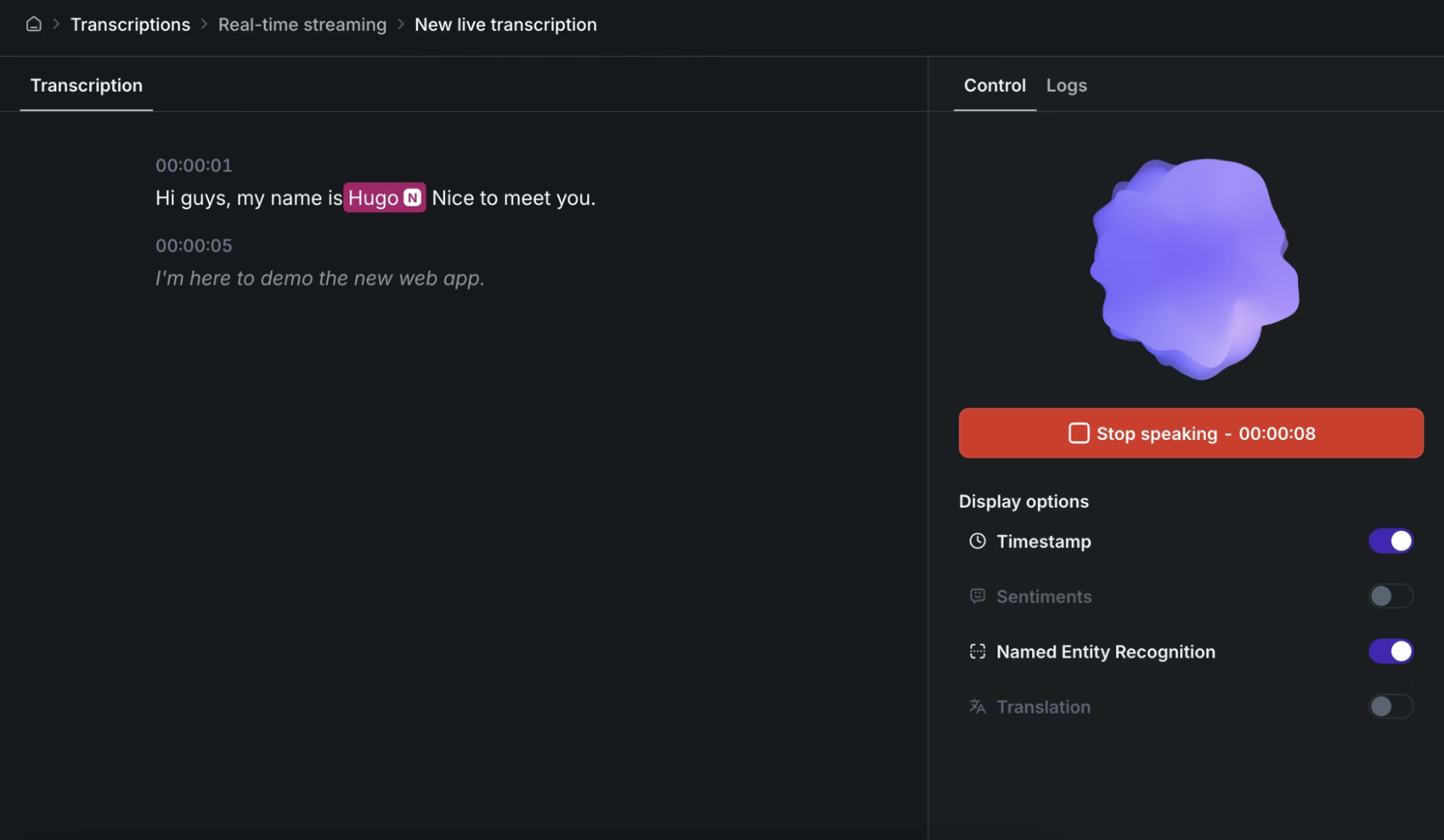
Audio intelligence features are accessible without additional per-feature charges through Gladia's pricing structure. Speaker diarization (powered by pyannoteAI's Precision-2 model, a notable technical partnership), word-level timestamps, sentiment analysis, summarization, and named entity recognition are all available through the same API. This approach simplifies budgeting and ensures developers have access to comprehensive capabilities without navigating complex pricing tiers.
Beyond general accuracy, Gladia also focuses on precision by accurately transcribing specific entities such as email addresses, names, and numbers. Features like custom vocabulary with per-term weighting and named entity recognition allow users to prompt the model with specific terminology, improving entity detection in specialized domains like medical, financial, and legal transcription.
Real-time transcription performance compared
Both platforms deliver impressive real-time transcription capabilities, but with different architectural approaches and performance characteristics.
Deepgram offers real-time transcription with latency under 300 milliseconds through its WebSocket-based streaming API. The platform is designed to handle high volumes of concurrent streams with scalable infrastructure.
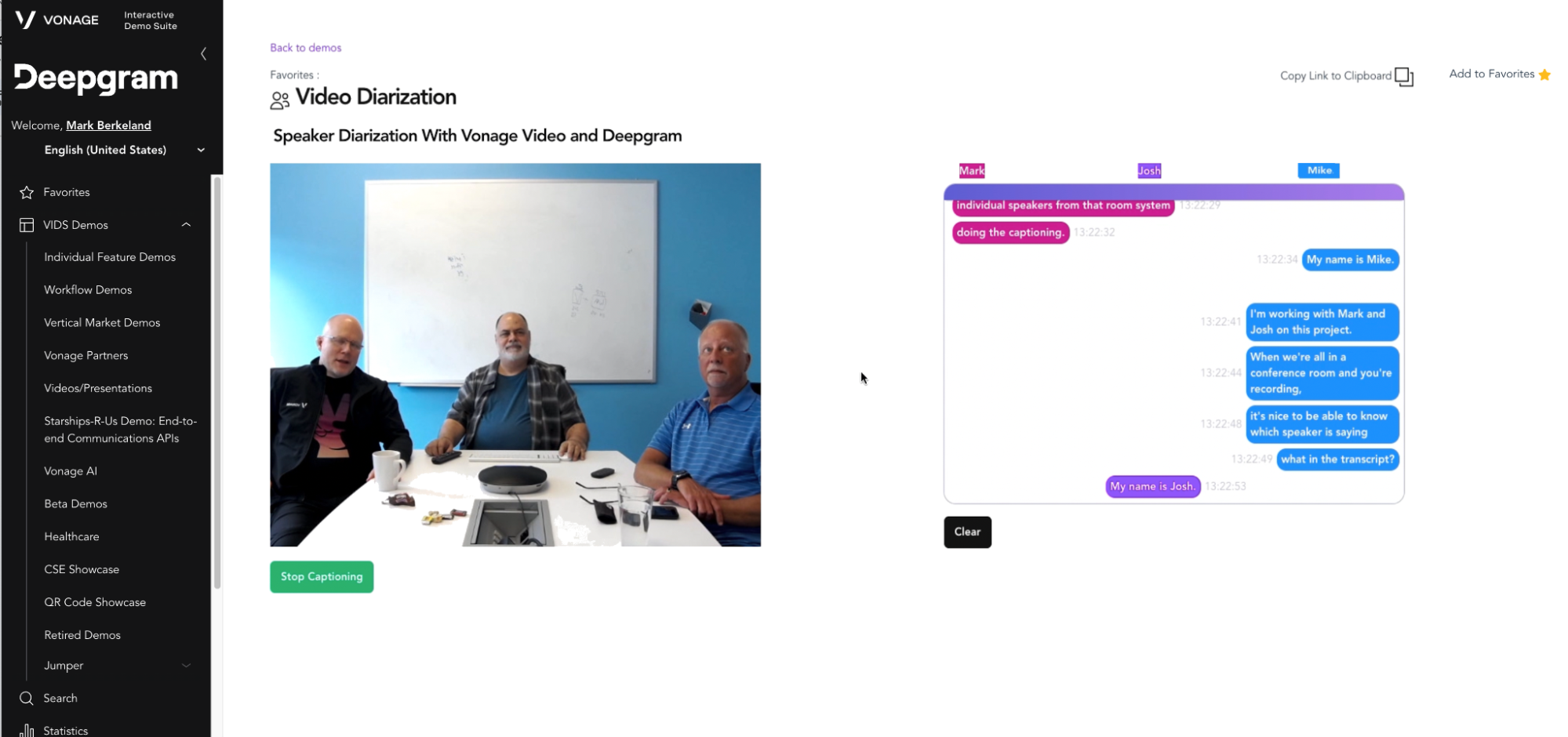
The company's real-time processing supports features like interim results (providing immediate feedback before final transcription) and speaker diarization during live streams. For voice agent applications, the unified Voice Agent API handles the additional complexity of coordinating speech-to-text with LLM processing and text-to-speech output, managing turn-taking and interruption handling natively.
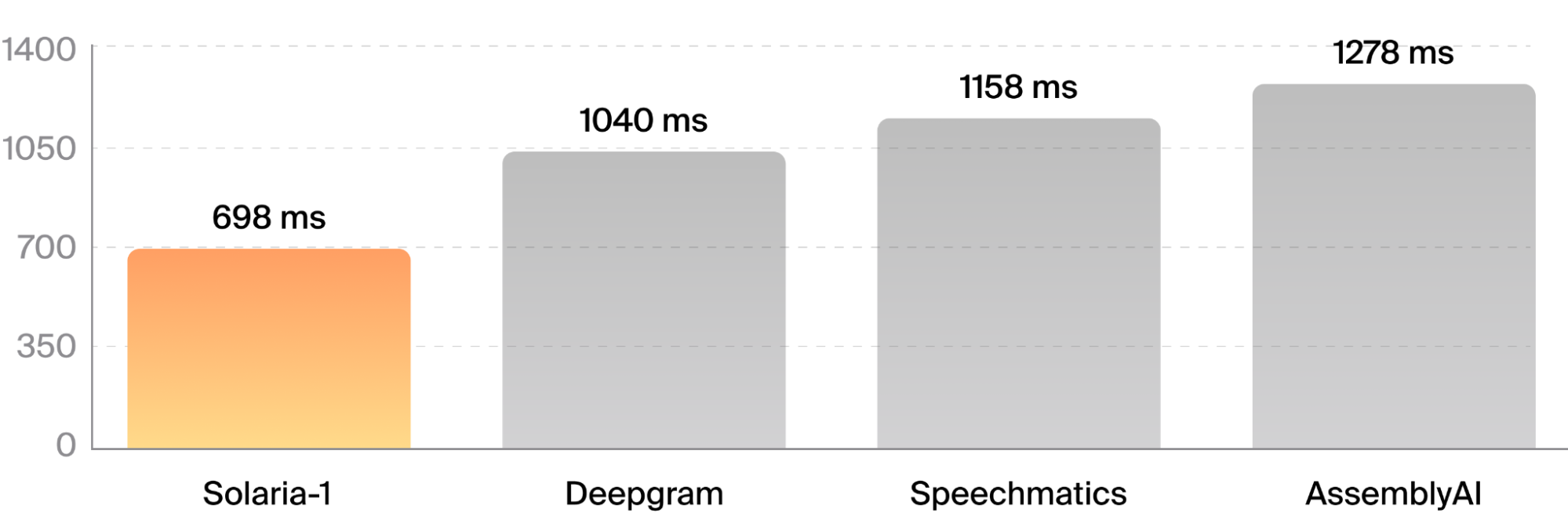
Gladia takes a real-time-first approach, having designed its architecture from the ground up for conversational use cases. The Solaria-1 model delivers partial latency under 103 milliseconds, which is approximately twice as fast as competitors on this metric, which is critical for voice agents where responsiveness determines user experience. Final transcript latency comes in at approximately 270 milliseconds.
Understanding the distinction between these latency metrics matters for different use cases. Partial latency (time to first transcript output) is crucial for voice agents where users expect immediate acknowledgment of their speech. Final latency (time to complete, corrected transcript) matters more for accuracy-critical applications. Gladia's architecture optimizes for both, achieving what the company describes as "human-like latency" that enables natural, uninterrupted conversational speech.
Gladia's real-time API supports the same audio intelligence features available in batch processing, including sentiment analysis and named entity recognition, with results streamed back through the WebSocket connection. The code-switching capability works in real-time, allowing the system to dynamically detect and transcribe when speakers change languages mid-conversation.
Both platforms support concurrent connection limits that scale with pricing tiers.
Deepgram offers up to 150 WebSocket connections on its Pay-As-You-Go plan, while Gladia provides 30 concurrent real-time requests on its Self-Serve plan, with higher limits available on enterprise tiers. Gladia offers both US East and US West clusters for faster API response and data sovereignty, with the platform built to handle high-volume workloads without requiring self-hosting for stable, low-latency streaming.
Audio intelligence features and bundling approaches
Deepgram treats audio intelligence as modular add-ons to the base transcription.
Per-minute features like speaker diarization, redaction, and keyterm prompting are billed separately: speaker diarization adds $0.0020 per minute, redaction adds $0.0020 per minute, and keyterm prompting adds $0.0013 per minute. A separate set of Audio Intelligence capabilities, including sentiment analysis, summarization, topic detection, and intent recognition, are powered by task-specific language models and priced per token ($0.0003/1k input tokens, $0.0006/1k output tokens) rather than per minute.
This token-based billing makes direct per-hour cost comparisons impossible for these features. Notably, translation and entity detection are not currently available as Deepgram STT add-ons.
This modular approach provides flexibility for organizations that only need specific features. A company focused solely on transcription accuracy can avoid paying for intelligence capabilities it won't use. However, for organizations that need comprehensive audio analysis, the add-on costs accumulate and require careful management.
Deepgram's audio intelligence is accessible through simple API parameters. Setting diarize=true enables speaker identification, while sentiment=true activates emotional tone analysis. The API returns structured JSON responses with the analysis results organized by segment, including confidence scores for each determination.
Gladia includes audio intelligence features as part of its base pricing. Speaker diarization (powered by pyannoteAI's Precision-2 model), word-level timestamps, sentiment analysis, summarization, and named entity recognition are available without additional per-feature charges.
This bundled approach allows teams to move from basic transcription to full audio intelligence without additional procurement because everything is available instantly rather than requiring separate add-ons.
The summarization feature offers three modes: general overview, concise snapshot, and bullet points for key takeaways. Sentiment analysis identifies emotional tone at the sentence level and, when combined with diarization, attributes sentiment to specific speakers. Named entity recognition automatically extracts people, organizations, locations, dates, and email addresses from transcripts.
Both platforms support custom vocabulary to improve recognition of domain-specific terms. Deepgram's approach allows custom model training for enterprise customers, while Gladia provides a custom vocabulary feature with dynamic, per-user, per-language, and per-term weighting capabilities, enabling high precision without full model retraining.
Pricing models reveal different philosophies
Deepgram uses per-minute pricing with rates varying by model and feature. On the Pay-As-You-Go tier, Nova-3 Multilingual streaming costs $0.0092 per minute, while the Growth tier (requiring $4,000+ annual commitment) reduces this to $0.0078 per minute.
New users receive $200 in free credit with no expiration on Pay-As-You-Go plans.
The Voice Agent API is priced separately, starting at $0.08 per minute on Pay-As-You-Go while Text-to-Speech (Aura-2) pricing begins at $0.030 per 1,000 characters. Per-minute add-on features like speaker diarization ($0.0020/min), redaction ($0.0020/min), and keyterm prompting ($0.0013/min) carry their own rates on top of base transcription costs.
Audio Intelligence features (sentiment analysis, summarization, topic detection, and intent recognition) are priced per token rather than per minute, using a separate billing model.
Enterprise pricing is custom and includes access to custom model training, priority support, higher concurrency limits, and self-hosted deployment options.
Gladia uses per-hour pricing with a simpler, all-inclusive structure.
The Self-Serve tier costs $0.75 per hour for real-time transcription and $0.61 per hour for asynchronous. The Scaling tier (contact sales required) reduces these to $0.55 and $0.50 per hour, respectively.
All Self-Serve users receive 10 free hours of transcription per month. Audio intelligence features, including speaker diarization, sentiment analysis, summarization, and named entity recognition, are included in the base pricing with no additional charges. This transparent approach means no hidden costs or surprise add-ons.
To understand the true cost difference, it's important to compare equivalent feature sets using multilingual models, since Gladia's pricing inherently includes 100+ languages and all audio intelligence features. For real-time streaming with speaker diarization:
Gladia Self-Serve (includes diarization and all features): $0.75/hour
Gladia Scaling (includes diarization and all features): $0.55/hour
However, this comparison still understates the difference in total cost.
Adding Deepgram's other per-minute add-ons (redaction at $0.0020/min and keyterm prompting at $0.0013/min) brings the Deepgram total to approximately $0.75/hour, matching Gladia's Self-Serve rate before accounting for Audio Intelligence features.
Deepgram's sentiment analysis, summarization, topic detection, and intent recognition are billed per token using a separate pricing model, making a direct per-hour comparison of the full feature set impossible. Additionally, translation and entity detection are not available as Deepgram add-ons, while Gladia includes named entity recognition and translation in its base pricing.
The net result: Gladia's Scaling tier at $0.55/hour includes all features, while achieving a comparable feature set with Deepgram requires layering multiple per-minute and per-token charges that can exceed Gladia's Self-Serve rate.
Gladia's pricing also does not require customers to share data for model training, whereas Deepgram's listed rates assume participation in their Model Improvement Program.
Security, compliance, and data privacy
Both platforms maintain robust security postures appropriate for enterprise deployments, but differ significantly in their approach to customer data.
Access control is managed through API keys with role-based permissions. Two-factor authentication is utilized for system access. Deepgram maintains access controls for customer data, with employees bound by confidentiality agreements.
Regarding data usage for training, Deepgram operates a Model Improvement Partnership Program that uses customer audio to improve models by default. Customers can opt out by adding mip\_opt\_out=true to API requests, but doing so means forgoing up to 50% in pricing discounts. This creates a trade-off between cost savings and data privacy.
The on-premise deployment option gives organizations complete control over their data. For self-hosted deployments, Deepgram supports licensing through container orchestration tools like Kubernetes, with a License Proxy for high availability that allows continued operation even if connectivity to Deepgram's servers is temporarily lost.
Gladia holds SOC 2 Type 1 and Type 2 certification and is HIPAA compliant. The platform is GDPR compliant by design, with primary processing on European infrastructure. Encryption covers all data in transit (TLS) and at rest using established encryption algorithms.
A key differentiator is Gladia's approach to data privacy as a non-negotiable value rather than a paid feature. For all paid plans (Scaling and Enterprise), customer audio is never used for model retraining, and this comes with no forfeiture of discounts or additional charges. Only Free-tier users' data may be used for training purposes. As Gladia positions it: "Your data is not a bargaining chip."
Data retention is configurable, with options including 1-month, 1-week, 1-day, and zero-day retention for enterprise customers. Gladia's European headquarters in Paris and infrastructure options make it particularly attractive for organizations with GDPR requirements or privacy-conscious policies.
On-premise and air-gapped hosting options are on Gladia's roadmap for enterprise customers but are not yet generally available. Currently, Gladia delivers transcription services through cloud-hosted environments that can be customized to geographic requirements.
Deepgram vs Gladia: Which should you choose?
The choice between Deepgram and Gladia depends on your specific requirements, technical capabilities, and strategic priorities.
Choose Deepgram if:
You need a comprehensive voice AI platform with text-to-speech and voice agents beyond transcription
Custom model training for specialized vocabularies is essential for your use case
You require on-premise deployment with maximum infrastructure control today
You're building conversational AI agents internally and want unified speech-to-speech capabilities from a single vendor
Your team has the resources to manage a more complex platform with modular pricing
You prefer proven scale with over one trillion words transcribed
You're comfortable with data being used for model training (or willing to pay more to opt out).
Explore Deepgram's comprehensive voice AI platform
Choose Gladia if:
Your primary need is high-accuracy, real-time transcription with industry-leading partial latency (under 103ms)
You're building voice agents, CCaaS, meeting assistant or other products and want an STT provider that won't compete with you
Code-switching between languages is common in your audio content
You want audio intelligence features included without add-on complexity
Data privacy is non-negotiable, you don't want to pay extra to protect your data
European data residency or strong GDPR compliance positioning matters to your organization
You prefer transparent per-hour pricing with predictable costs
Your team values developer experience and rapid integration
You need to serve international markets with diverse accents and languages.
Start transcribing with Gladia's 10 free hours per month
The speech-to-text API market in 2026 offers strong options for different needs.
Deepgram has built a comprehensive voice AI infrastructure that serves as a one-stop platform for organizations wanting to consolidate their voice technology stack. Its custom model training, text-to-speech capabilities, and unified Voice Agent API provide flexibility for complex enterprise deployments where vendor consolidation is a priority.
Gladia has established itself as a pure-play speech AI alternative that prioritizes transcription excellence, developer experience, and transparent practices. Designed as a real-time-first, async-ready platform, its included features, strong multilingual capabilities, and commitment to never training on customer data (for paid plans) make it particularly attractive for teams building on top of speech AI who want a vendor that will remain a partner, not a competitor.
Your decision should align with both your immediate transcription needs and your longer-term product strategy.
Organizations planning to build comprehensive voice applications in-house may find Deepgram's platform breadth valuable. Those focused on getting accurate, real-time transcripts into their applications quickly, especially in international or privacy-conscious contexts, will appreciate Gladia's focused and transparent approach.
Contact us
Your request has been registered
A problem occurred while submitting the form.
Read more
Speech-To-Text
GDPR compliance for meeting transcription: DPA requirements, data residency, and HIPAA options
Speech-To-Text
Speechmatics vs. Gladia: accuracy, pricing, and real-world performance
Speech-To-Text
From transcript to actionable notes: Building effective LLM pipelines for meeting intelligence
From audio to knowledge
Subscribe to receive latest news, product updates and curated AI content.
Thank you! Your submission has been received!
Oops! Something went wrong while submitting the form.


.png)
.png)
.png)