Lorem ipsum dolor sit amet, consectetur adipiscing elit, sed do eiusmod tempor incididunt ut labore et dolore magna aliqua. Ut enim ad minim veniam, quis nostrud exercitation ullamco laboris nisi ut aliquip ex ea commodo consequat. Duis aute irure dolor in reprehenderit in voluptate velit esse cillum dolore eu fugiat nulla pariatur.
TL;DR: Native Microsoft Teams transcription via the Graph API delivers transcripts only after a meeting ends, provides utterance-level (not word-level) timestamps, and degrades sharply on accented or multilingual speech. For any product that routes Teams audio to downstream AI systems, the more reliable architectural pattern is capturing raw audio via a custom WebRTC bot and routing it to a managed STT engine, one that delivers word-level timestamps, accurate multilingual handling, and predictable per-hour costs, none of which the native Graph API provides. Solaria-1 covers real-time streaming and broad language support. Solaria-3 is optimised for European business audio.
Podcast transcription at scale: an API workflow for media platforms
TL;DR: Podcast audio is invisible to search without accurate, word-level transcripts, and transcription quality sets the ceiling for everything downstream, from content discovery to AI-generated show notes. A production-grade async pipeline (decoupled webhook ingestion, pyannoteAI-powered diarization, word-level timestamps) is what separates a searchable audio library from a title-and-description catalog. At 10,000 hours monthly, a managed API costs $2,000–$6,100 depending on plan.
HIPAA-ready meeting assistants for healthcare and therapy sessions
TL;DR: Building a HIPAA-ready meeting assistant requires more than a generic transcription wrapper. Any API that processes Protected Health Information on your behalf must sign a Business Associate Agreement (BAA) before PHI flows to it, and transcription accuracy matters more than most teams expect: word error rate can more than double in noisy, multi-speaker clinical environments compared to controlled recordings, meaning errors compound into every SOAP note and EHR entry downstream. This guide covers the BAA requirements, encryption controls, and unit economics product teams need to evaluate before committing to an audio infrastructure provider for clinical or therapy use cases.
Powering virtual meetings with Speech to Text AI: Claap's success story with Gladia
Published on Jun 25, 2023
A case study showcasing the benefits of Gladia's AI API for Claap, an all-in-one video workspace that implemented our solution to provide its international users with advanced video transcription capabilities.
Meet Claap
Claap is a leading all-in-one video workspace that helps organizations speed up decision-making by reducing back-to-back virtual meetings and endless messaging threads. Claap unifies meeting recording, screen recording, and a video wiki into a single collaborative workspace, unlocking a new level of alignment, transparency, and efficiency.
Founded in France in 2021, the company serves international customers like Revolut, Kavak, and Qonto, and helps them solve their remote collaboration challenges.
• 14 employees
• 5,000+ customer workspaces
• Global user base: French, English (US/UK), Spanish, German, Dutch, Danish, Chinese, Hindi, Portuguese, Italian and other languages in use
Claap's platform with built-in transcription, powered by Gladia
Claap’s team knew that in order to realize their vision, they needed to make video content a truly intuitive medium of information. This, in turn, meant that they had to make video content easy to summarize, categorize, search, and digest. A high-quality transcription tool was therefore crucial to their roadmap.
Challenge
Claap’s Co-founder and CTO, Thomas Hernandez, needed a highly accurate, fast, and easy-to-implement multilingual solution both for core transcription and for video intelligence add-ons.
While the Claap team considered building the solution in-house using a layer of add-ons on top of an open-source product, they felt that transcription was becoming enough of a commodity that a specialized API provider would be a better fit, thanks to reduced time-to-market and lower infrastructure costs.
The issue they encountered, however, was that the incumbent providers did not meet the near-perfect quality they were looking for, as they were primarily US-centric, with lower quality for non-native English speakers. They were also either too slow, or prohibitively expensive.
Objectives
To deploy a high-quality, scalable video transcription API and audio intelligence add-ons for all Claap's customers all around the globe.
Specifications
✔️ A high-quality transcription at a scalable cost so it could be deployed in every user space.
✔️ A solution adapted to speakers from multiple geographies, with different languages and regional accents.
✔️ A transcription technology that is fast enough to add a valuable layer of insight to user videos almost immediately.
Solution
With Gladia, the Claap team was able to implement:
A highly accurate transcription solution registering a WER between 1% and 3%.
Transcription at blazing speed, with one hour of video transcribed on average in under 60s.
A truly multilingual approach to transcription, with core features and add-on all available in 99+ languages.
A quick implementation and iteration cycle, with fixes and features released every week, as well as weekly client support.
Audio intelligence features such as speaker diarization, word-level timestamps, translations, and other features, enabling Claap to make content more accessible for their international users.
Thanks to our API, Claap was able to unlock the following AI-powered functionalities for its users:
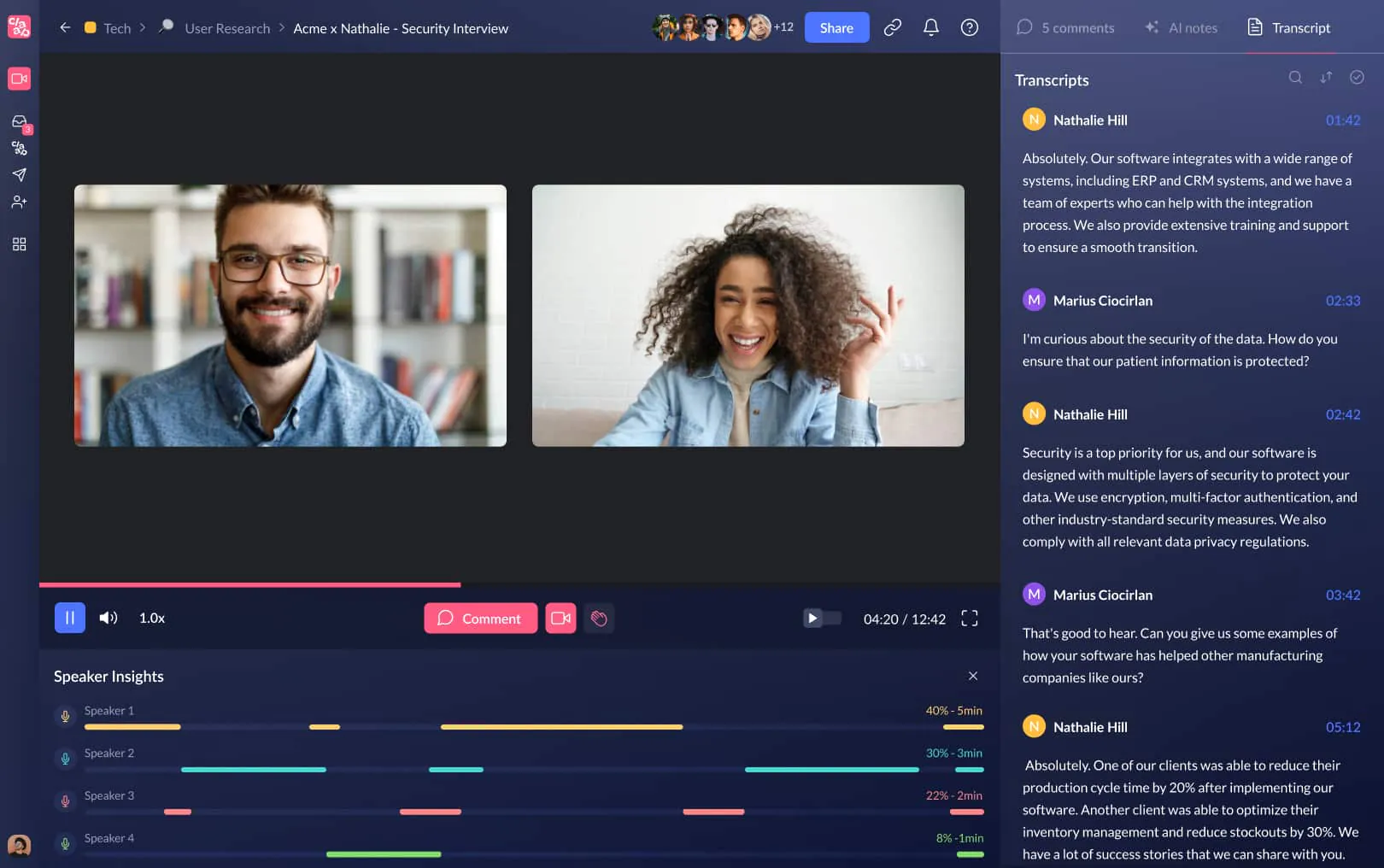
Synced playback — follow along with a video transcript while you listen to the recording;
Speaker detection — automatically detect multiple speakers to jump in the right moment;
Search within video — search the full text transcript and find the exact moment you’re looking for;
Add comments while watching transcript — easily add comments related to a specific timestamp.
Speaker diarization as seen inside Claap
Impact
After deciding to add audio transcription to their roadmap, Claap started testing the API immediately. By working with the Gladia team to iterate and scale up, they saw a noticeable impact on their own customers, from users praising the quality of the transcription to prospects converting specifically after trying it out.
In a nutshell, Claap's case study illustrates the many possibilities unlocked by audio AI for businesses, aiming to improve user experience, boost retention and upgrade its core product functionalities - all with a single turnkey API.
We're thrilled to have been part of this amazing journey, and we owe a huge thanks to our client for putting their trust in us. As we move forward, we're excited to team up with more clients, tackle new challenges, and make AI more accessible to companies worldwide.
About Gladia
Gladia provides a speech-to-text and audio intelligence API for building virtual meeting and note-taking apps, call center platforms, and media products, providing transcription, translation, and insights powered by best-in-class ASR, LLMs and GenAI models.
Having read this case study, do you feel like Gladia could be the right fit for your business too?