Lorem ipsum dolor sit amet, consectetur adipiscing elit, sed do eiusmod tempor incididunt ut labore et dolore magna aliqua. Ut enim ad minim veniam, quis nostrud exercitation ullamco laboris nisi ut aliquip ex ea commodo consequat. Duis aute irure dolor in reprehenderit in voluptate velit esse cillum dolore eu fugiat nulla pariatur.
Migrating from Azure Speech to Gladia: a step-by-step switching guide
TL;DR: Migrating from Azure Speech to Gladia removes the overhead of custom training pipelines and fragmented per-feature billing. Azure routes diarization, translation, and sentiment through separate services with separate billing meters. We bundle all audio intelligence into one per-hour rate on Starter and Growth plans. Solaria-3 ranks #1 for real-world European business audio, Solaria-1 covers 100+ languages with native code-switching. Both deliver out-of-the-box accuracy that eliminates custom training for most production audio. Most engineering teams complete the API refactoring in under 24 hours.
How to evaluate a speech-to-text API: a technical buyer's framework
TL;DR: Choosing an STT API on vendor benchmarks alone is how teams end up with transcription that looks fine in staging and breaks on production audio. A rigorous evaluation requires building a test set from your own calls, measuring word error rate (WER) on your specific audio distribution, stress-testing latency under concurrent load, and auditing data retraining terms before signing. This guide gives you a reusable engineering blueprint to run that evaluation end-to-end, the same methodology behind our own open async benchmark, which covers 7 datasets and 74+ hours of audio across 8 providers.
The contact center QA scorecard: what to measure and how transcription feeds it
TL;DR: Manual QA teams review as little as 1% to 2% of contact center calls, leaving the vast majority of interactions unreviewed and exposing systemic compliance risks that sampling never surfaces. Scaling to automated coverage requires transcription accurate enough to power LLM-based scoring without silent failures. If your speech-to-text engine misattributes a speaker or drops a compliance disclosure, every downstream scorecard, CRM entry, and coaching flag is wrong. French CCaaS platform Gravite cut per-call review time from 15 minutes to 1 minute (93% reduction) while automating coverage across their full 50,000 hours of annual call volume on infrastructure built for real-world contact center audio.
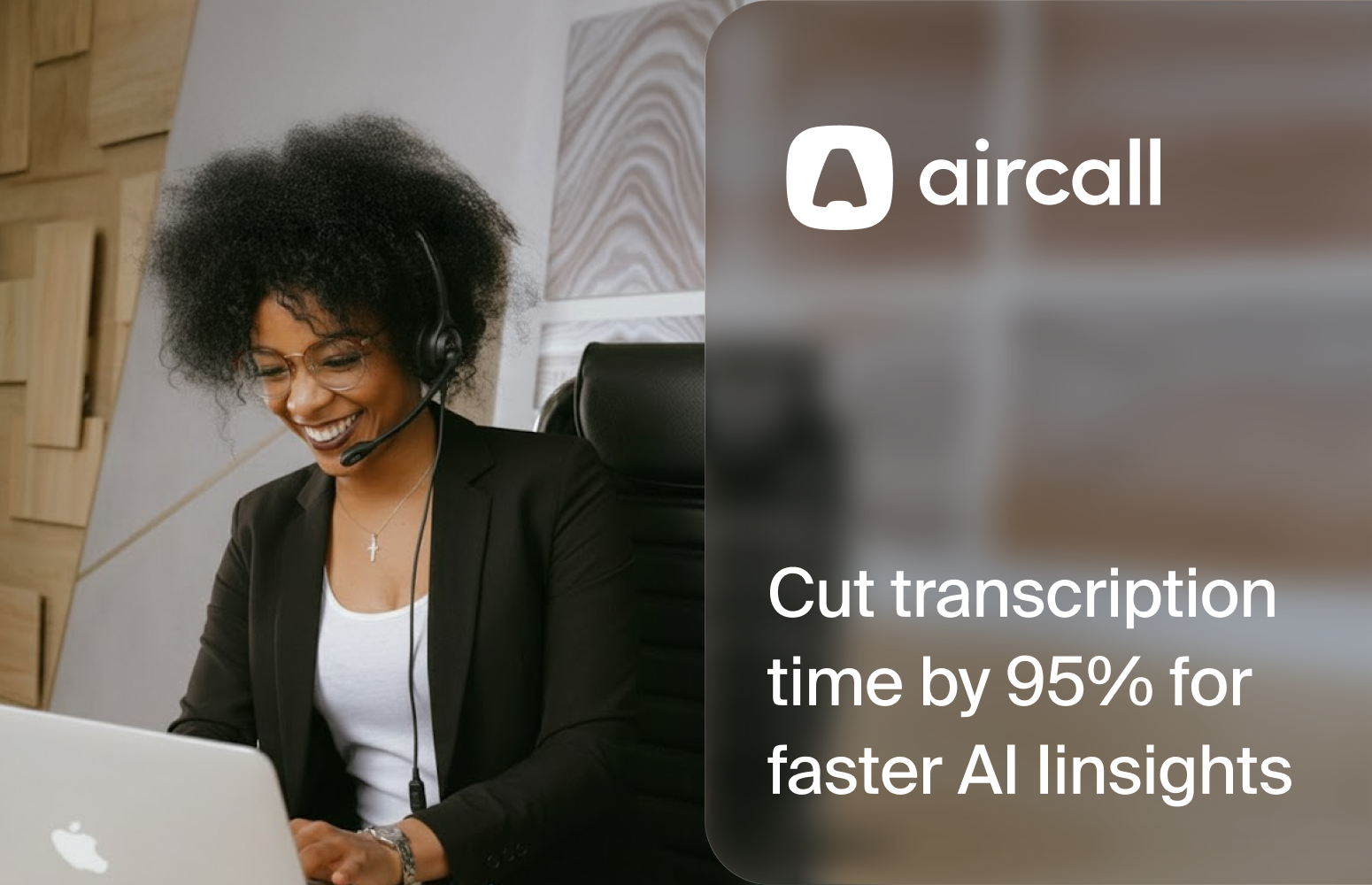
How Aircall cut transcription time by 95% with Gladia
Published on Oct 9, 2025
The contact center is transforming. Traditionally defined by manual workflows, siloed data, and reactive customer service, today's Contact Center as a Service (CCaaS) platforms are embracing a new era—one driven by real-time AI and automation.
Transcription lies at the core of this transformation. Converting voice to text with speed and precision unlocks a cascade of next-gen capabilities: automated summaries, sentiment detection, agent coaching, CRM enrichment, and more. But many legacy or in-house solutions fall short—too slow, too inaccurate, or too resource-heavy to scale.
Aircall, the leading AI-powered voice platform for growing businesses, recognized this inflection point early. To meet the growing demand for fast, intelligent insights from customer conversations, Aircall turned to Gladia’s speech-to-text API.
Here’s how Aircall reduced transcription time by 95%, empowered its users with near-instant insights, and laid the groundwork for a smarter, AI-driven CCaaS future.
About Aircall
Aircall is an integrated customer communications and intelligence platform. It unifies voice and digital channels into one seamless platform, offering one-click integrations with leading CRMs and over 250 business tools. With a strong focus on cloud-based voice solutions, Aircall helps teams streamline conversations, improve customer support, and drive sales efficiency.
Farid Issabhai, Staff Engineer at Aircall, is at the forefront of Aircall’s AI and transcription initiatives. He played a key role in integrating cutting-edge technologies, including Gladia’s speech-to-text API, into Aircall’s workflows.
Challenge: More accurate, fast, and scalable transcription for global telephony
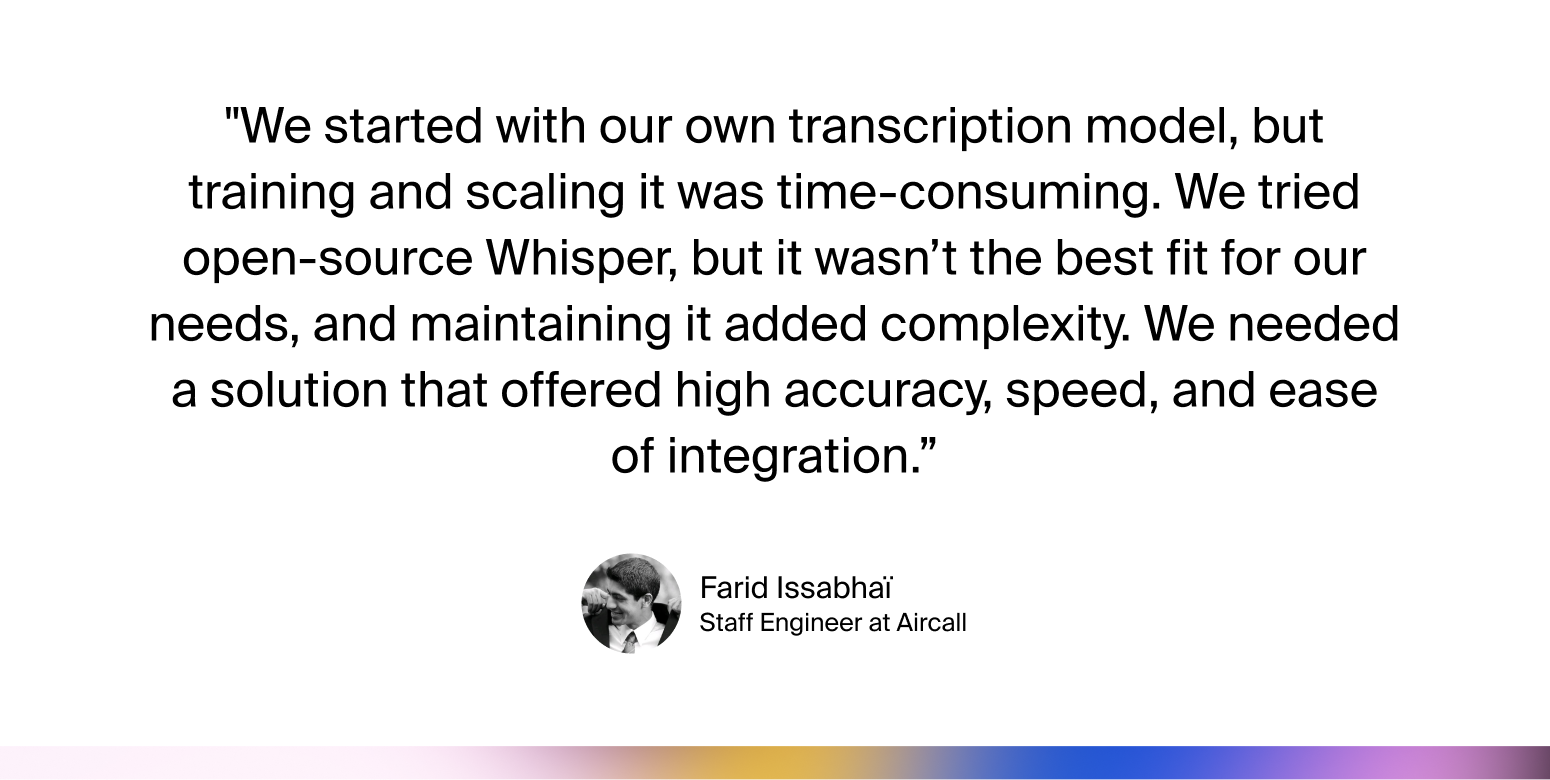
As a leading voice platform, Aircall processes thousands of calls every day across diverse languages and use cases, from customer support to sales interactions. Initially, Aircall developed an in-house transcription engine, but maintaining and improving it proved challenging.
Solution: Gladia’s speech-to-text API
After evaluating different STT API vendors, Aircall chose Gladia for its strong performance in transcription accuracy, especially for key strategic languages.
Gladia’s API allowed Aircall to:
✓ Transcribe calls across multiple languages like Spanish, German, and Italian.
✓ Process over 1M transcriptions per week
✓ Deliver transcripts significantly faster than their previous solutions.
How Aircall uses transcription
Aircall integrates Gladia’s transcriptions as a foundational layer for advanced features for their CCaaS platform:
Searchability: Users can search for keywords across calls
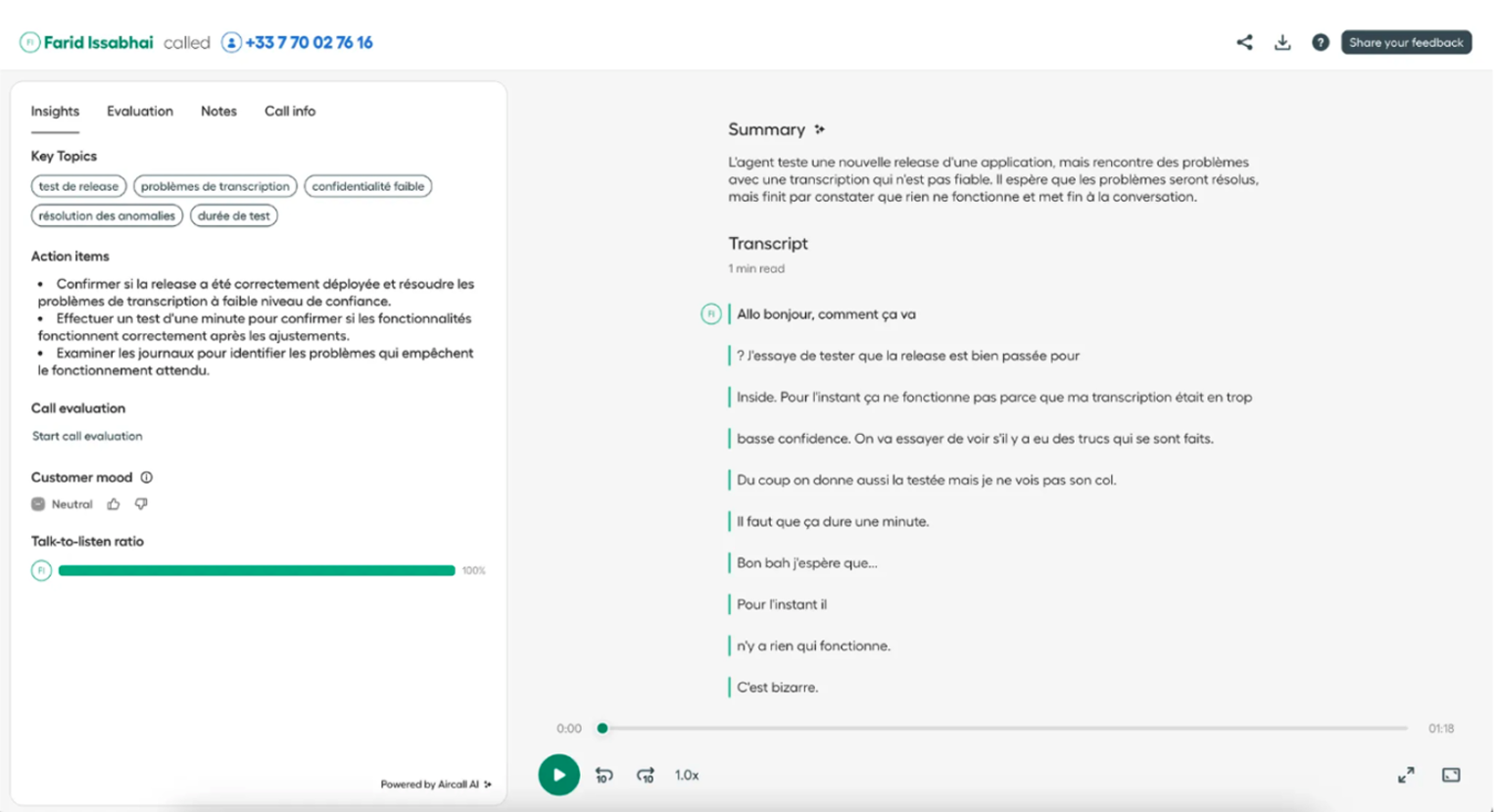
AI-generated insights: Summaries, key topics, and sentiment analysis are built on top of the transcripts
Agent coaching: Aircall’s coaching features assess calls for compliance and training, evaluating factors like greetings or responses to objections
CRM Integration: While transcriptions aren’t logged directly into CRMs like HubSpot or Salesforce, summaries and AI insights are pushed via webhooks
Farid explains,
Why Aircall chose Gladia
Aircall’s decision to partner with Gladia was driven by:
Accuracy: High performance across key languages benchmarked on internal datasets composed of phone call audio
Speed: Drastically reduced transcription delays
Developer Experience: A well-designed API that simplified integration
Cost-Effectiveness: A solution that balances performance with the economics of scaling
Results: Faster insights, smoother operations
Since switching to Gladia:
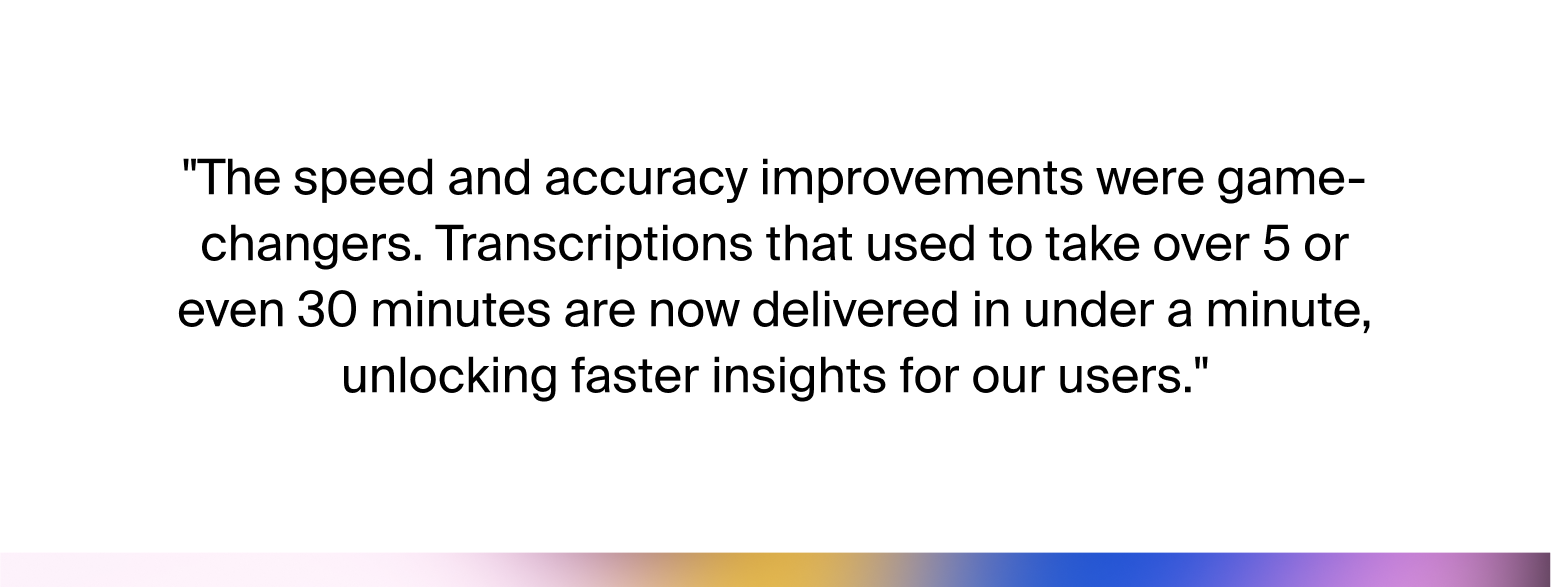
Transcription times have dropped from up to 30 minutes to under 1.5 minutes
Aircall processes around 1M calls weekly, enabling scalable AI features
Improved user satisfaction by delivering faster insights
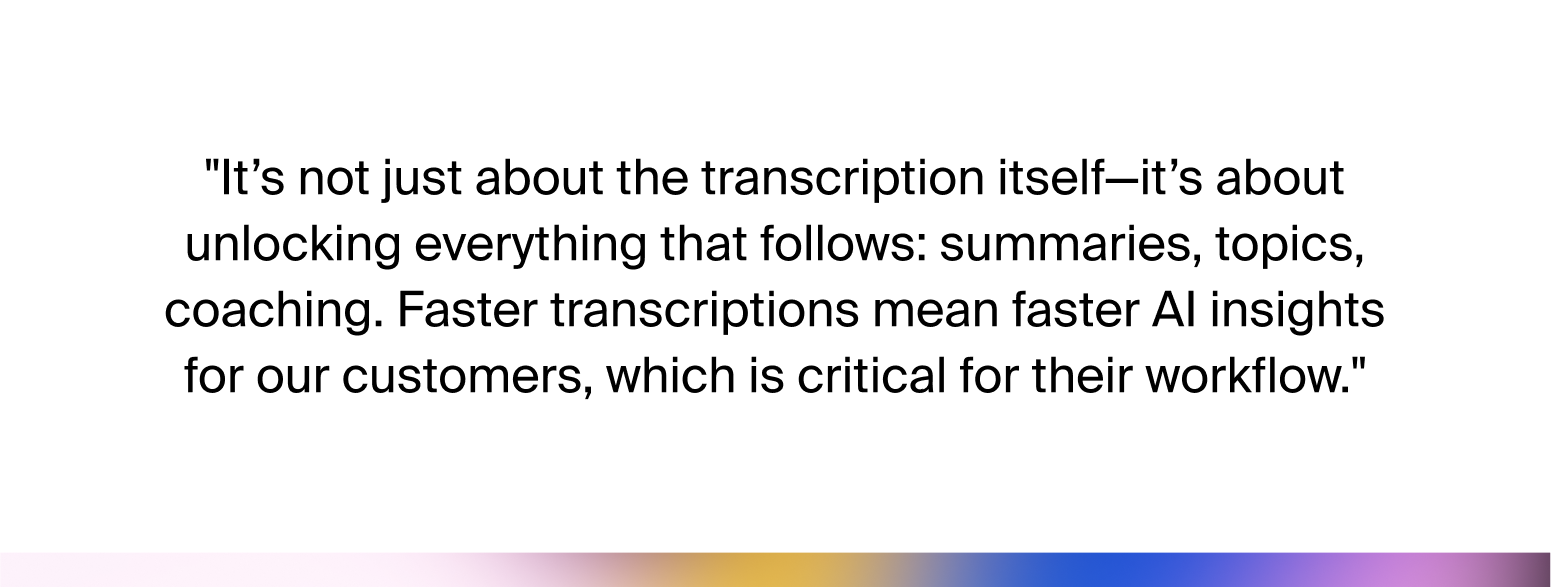
Farid highlights,
Looking ahead
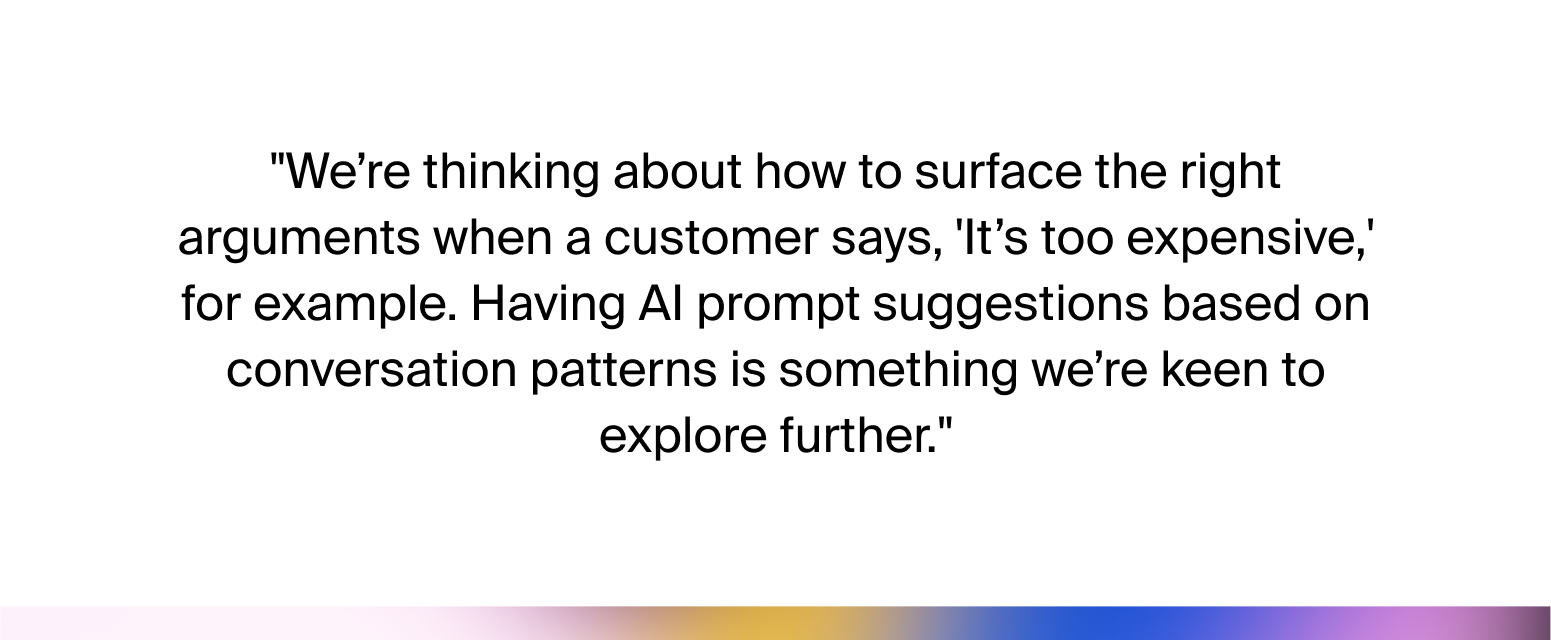
Aircall is exploring new frontiers with real-time transcription and AI voice agents. While asynchronous transcription currently meets most needs, the team is actively experimenting with new features like real-time assistance during sales calls, where AI can suggest responses based on conversation context.
Farid shares,
Final thoughts
Farid’s advice for companies looking to integrate speech-to-text AI:
About Gladia
Gladia provides a speech-to-text and audio intelligence API for building virtual meeting and note-taking apps, call center platforms, and media products, providing transcription, translation, and insights powered by best-in-class ASR, LLMs, and GenAI models.
After reading this case study, do you think Gladia could be the right fit for your business?