Lorem ipsum dolor sit amet, consectetur adipiscing elit, sed do eiusmod tempor incididunt ut labore et dolore magna aliqua. Ut enim ad minim veniam, quis nostrud exercitation ullamco laboris nisi ut aliquip ex ea commodo consequat. Duis aute irure dolor in reprehenderit in voluptate velit esse cillum dolore eu fugiat nulla pariatur.
MiFID II and FCA call recording: compliance for voice transcription in finance
TL;DR: Financial firms operating under MiFID II and FCA jurisdictions must maintain searchable, high-accuracy records of all client-related voice communications, including remote and mobile calls under FCA Market Watch 66. Engineering and product teams building for these obligations typically implement dedicated cloud infrastructure with defined data residency, controls that prevent customer audio from being used to retrain models on Growth and Enterprise plans, and transcription accurate enough that the resulting records hold up under regulatory review. Transcription and speaker attribution errors are not product quality issues in this context. They are audit trail failures, and regulators treat them as such.
Why speech-to-text accuracy matters upstream of your LLM
TL;DR: Downstream LLM performance is ceiling-bounded by upstream transcription accuracy. A transcript with a meaningful error rate doesn't produce proportionally degraded summaries or CRM entries. It produces outputs where hallucinated names, inverted logic, and misattributed speaker turns compound silently into every downstream system that reads them. Prompt engineering cannot recover information the STT layer never captured. Gravite cut call quality review time by 93%, from 15 minutes to 1 minute per call, once transcript accuracy was high enough to trust the output without manual verification.
TL;DR: Telephony audio is constrained to 8kHz narrowband frequencies, stripping away the high-frequency spectral energy that generic 16kHz STT models require. Standard upsampling cannot recover phonemes that were never captured at the source, leading to transcription errors that compound silently into downstream NLU failures. Solaria-3 ranks #1 on Switchboard, the most challenging conversational telephony dataset, ahead of AssemblyAI, ElevenLabs, Deepgram, Mistral, and Speechmatics, ensuring your downstream LLM pipelines receive clean, structured data from real-world noisy call audio.
AI-powered healthcare assistant enhances medical transcription by 120% with Gladia
Published on Feb 28, 2025
Medical transcription is among the most critical and challenging verticals for ASR models to date.
Filled with drug names and medical jargon, medical consultations, dictations, and online conferences require versatile solutions, with custom vocabulary and specialized models needed to make speech-to-text solutions attuned to jargon. There’s the issue of security too, as audio from medical consultations is among the most sensitive confidential data out there.
A fast-growing healthcare generative AI startup, who prefers to remain anonymous, turned to Gladia for top-quality medical transcription at scale. Here’s how we helped them increase their accuracy and speed of transcription, all while ensuring 100% security of confidential user data.
Challenge
Doctors spend about 60% of their time on computers, doing non-clinical work. This startup is aiming to get that number to 15%, enabling doctors to allocate most of their time for consultation, diagnostics, and other high-value tasks with the help of AI.
They knew that having accurate transcription for note-taking during consultations was the first step in designing a holistic solution to achieve this milestone.
Indeed, the platform’s ability to understand and actively transcribe jargon-filled medical conversations is an essential prerequisite for LLM-powered notes, prescriptions, and intricate EHR enrichment that distinguish their AI co-pilot.
Speed is likewise a key factor for them, as the ability to generate notes shortly after the consultation is critical for efficient clinical workflows.
Moreover, they needed to ensure 100% protection of all user data in accordance with HIPAA and GDPR, which most of the US-based providers are generally not able to provide.
This is why their team took the task of choosing a speech-to-text provider very seriously. With regular evaluations in place, they have tested over 7 different providers before, including the Big Tech cloud solutions — all of which ultimately failed to strike the right balance between accuracy, speed, price, and security standards.
Following a swift onboardingwith our tech team, they began to use Gladia as its primary speech-to-text provider. The results did not take long to show.
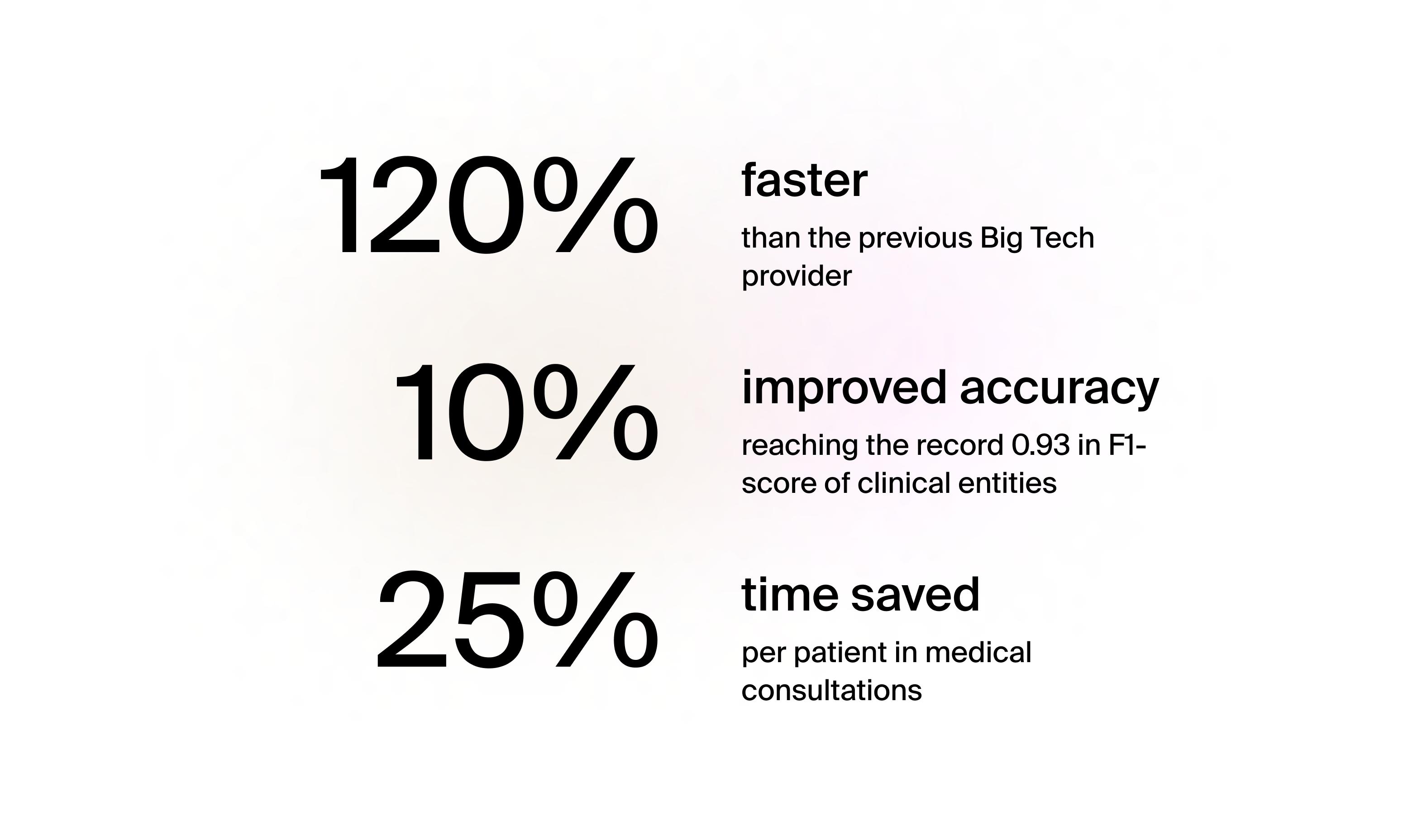
By working with the Gladia team to iterate and scale up, they saw a noticeable impact on their system’s performance:
The team was likewise impressed by the quality of Gladia’s technical assistance, allowing them to not only set up their dedicated environment in a matter of hours but also benefit from Gladia’s in-house engineering expertise to optimize their infrastructure as a whole.
Given the initial success with Gladia API and its on-premise deployment, this innovative company is already considering how they will leverage our product in the future as they extend their platform to new stakeholders.
For instance, they look forward to experimenting more with multilingual transcription and translation, which would enable patients to consult physicians in their native language. They also intend to leverage speaker diarization for collective medical meetings.
About Gladia
Gladia provides a speech-to-text and audio intelligence API for building virtual meeting and note-taking apps, call center platforms, and media products, providing transcription, translation, and insights powered by best-in-class ASR, LLMs and GenAI models.
Having read this case study, do you feel like Gladia could be the right fit for your business too?